As I began writing this, I was just home from a jubilant evening celebrating some of the many, many artists who worked incredibly hard to create 12 shows that our community were able to enjoy over five days.
Between Words should be commended for their continued work on this festival. With only four years under it’s belt, the festival’s success has forced a move into the larger Patrick Stewart theatre at the Belfry! This year, there were several nights of almost or fully sold out shows.
So many of the names and faces in the programme were new to me, and I think it’s just so wonderful to have an opportunity to get to know more of the artists in this community – I can see such passion and enthusiasm, and filled with such a palpable sense of community. This whole week really was a love letter to theatre!
While I didn’t see every night, I was thrilled to catch June 3rd – June 6th’s shows.
Please note: Spoilers ahead! I’ll try to keep as much as I can under wraps, but I’m going to be talking about the scripts so if you plan to catch later re-mountings read ahead with caution!
The Landlord’s Game
I adore the madcap, almost campy retelling of history, and the admittedly fascinating history of The Landlord’s Game was a surprising joy to delve into. As someone with a pretty well stocked board game cabinet, Monopoly is not high on my list, so to make the genesis of the game interesting was a high ask. And somehow, playwright Sean Weeks made it utterly fascinating to delve into.
The play did focus on the creation of the game, but also the friction between political and religious ideologies, and the ever-present capitalist desire to make a sale. With all these aspects moving quickly in and out of the dialogue, one might assume it gets wordy or weighed down, but it never does. A strength of the script was that it assumed you were along for the ride, nothing was talking down, nothing was looking down it’s nose, it was simply going on a journey with you.
The energy of all the performers was quite high throughout, and I felt at times it needed a bit more balance with grounded character work. I was delighted to see (new to me actor) Spencer Ronnenkamp provide so wonderfully in every scene he played as Jonathan Aberforth. His character could have easily teetered over to a caricature, but Ronnenkamp leaned into every opportunity for clever repartee and lovely sweetness – a challenging mix! Paired across from Jas Wong as his wife, Madeline, the pair had such genuine love and chemistry, it was a delight to see them in scenes together.
I hope this play continues on and we see it on stage again! If we see it again, I hope there are more musical numbers, or it is transformed into a play entirely. The musical numbers were a bit too sporadic and the dialogue too much between numbers so it didn’t feel the flow of a musical.
The visual design of this show was very clever. For the time and the money put into the show, the costumes were quick and effective (anachronistic but they completely worked), and the set pieces were moved quickly from place to place without stopping the flow – incredibly difficult to so! The visuals of the stage design were brilliant, the floor being made into a massive board game, and set pieces being made out of old broken down board games.
Finer, Further, Faster
This was an incredibly ambitious show in terms of scope – a high stakes sort of prison break in space, combining the ethics of human cloning (sort of), with the ethics of selling what is most precious to us. It’s a high stakes premise that touches at our heartstrings and asks us to think about what makes us who we are.
Zero wakes up, only to discover that she’s a robot, and the memories she has are “just” copies of someone else’s. She feels them so deeply, to her, they are who she is and what she has experienced. We find quickly that there are three other clones, and they are all ready to escape the clutches of a mad scientist who is determined to continue this program with no ethics or oversight. I was surprised at the genuine pathos that the show leaned into. At times, the strangeness of science fiction alienates viewers from the true emotions that are in the text, but Finer, Further, Faster leans into the emotion and true pathos.
Overall, this was a strong production that told a big story quite effectively. I do feel a bit more direction could have helped bring some energies down, and others up, as sometimes the tone being portrayed by different actors in the same scene was not quite a match.
This play used a number of projections to set time and place, and for the first few times they they are helpful. I did feel that the mechanic of it felt unnecessary sometimes and paired with a full blackout and music cue, it added length to a show that didn’t need it.
I could easily see this piece being fleshed out to a full length production, as I would have loved a little more time to get to know each of the clones a bit better – it’s a joy to know them each as much as we did!
The Death of the Sun
In the last eight minutes of sunlight before the sun dies, three people live their lives, reaching out, and making the most of their time remaining. It’s such a stark premise and so clearly distills what is important in the face of impending loss.
Presented to us in three monologues, this play had an incredible amount to offer viewers. A gardener speaks to her sunflower, wondering if she should humanely end it’s life now, but takes us on a journey through her life and her hopes. An evangelist struggles with the crushing doubt of what their faith has asked of her. A radio host calls out to their audience, asking if anyone knows them, looking for connection right to the end.
I felt that the three monologue structure was quite effective, and to cleverly tie them together made sense but didn’t feel contrived or forced – it added a next logical layer to the stories we were hearing.
Using an intentionally pared-down set with minimal props and basic costuming, this gave a simple but effective platform for the three actors to thoroughly develop their characters. All had the difficult task of answering a phone call in their piece, which seems so basic, but is something I see consistently go wrong on stage. Instead, all three used that limitation to great effect and were thoughtful and convincing. The character of the Radio Host was played by Mo Hatch quite effectively, balancing this so-human commitment to keep doing their job right to the end, aligned with utter panic, and desire to connect at the same time. I felt so connected to each of these characters, in their time of hopeless frantic actions, and appreciate the team that brought them all to life.
Game Night
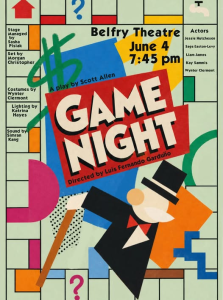
When you see someone having fun, you just want to join in, and that’s what Game Night was all about. In the very best way, it was a high octane board game night from hell. In the second Monopoly themed play of the festival (and yet so very different!), a group of friends are pre-gaming… er, “preparing” for a night out at the movies, only to have their pal show up with their new to them vintage copy of Monopoly.
In an edible-fueled haze, the Monopoly Man shows up and the house rules of Monopoly come head-to-head with the quirks of all the players. This show was incredibly fun, and the actors took every possible moment for comedy, each had incredibly fun dialogue and physicality in their roles.
I will note that as fun as it was, a few times, the energy went past frenetic and what should have been a staccato delivery of lines did end up treading on one another’s words. This was few and far between and for the most part, the madcap energy was effectively contained at a rolling boil throughout. This play knew what kind of comedy it was going for, and it absolutely delivered, laugh after endless laugh.
Motherland
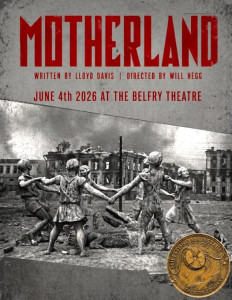
Motherland invited us to the true story of a Soviet-era team of female snipers. While this story is fiction, the true history behind these women is fascinating.
This was perhaps one of the most detailed of sets this festival, we see the women’s barracks, made as comfortable as a WWII era soviet front-line bunker could be. We get to know Dasha, Petra, Anya, and their commander, Marina. The show begins as Anya is returned in a coordinated prisoner transfer, with Hans the German being returned to his base.
We spend most of our time with these four women, and there is such a genuine and tender affection and collegiality between the women, and even at times, even a warmth from their commander. There’s such a palpable strength in the bonds between the women, and they are so beautifully brought to life by this ensemble.
As a piece of theatre, this was very polished and strong overall with impactful and purposeful movements between scenes, and as I mentioned above, an overall very strong ensemble. While I think the script was well written, I think there’s a few particular areas where structurally I would make a few recommendations. I think first and foremost the play is in an awkward place where there is too much content for a one act, so it either needs to be made longer or more content needs to be cut. There are so many great ideas and concepts that are touched on that don’t get to be fully fleshed out, I know I would love to hear more!
As a viewer, I struggled mostly with the love plot between Dasha and Hans. I understand the concept that love can bloom in the most hateful places, times, and between people who we never expect. That’s the beauty of who we are as humans. However, as we know, the Soviets were fighting Germans at that front in WWII. So, the love story does involve a Nazi soldier. I struggled with this. In 2026, as there are actual Nazis around, I just don’t like seeing a love story with a Nazi. And I know this is part of a bigger conversation, and I suspect there was probably relevant content that was cut for time.
What I felt was so impactful about Dasha as a character was her tormented back and forth as she balanced her duties as a human, and her perceived duty to the motherland. We were with her as she was wrangling with her experiences of the war as a Soviet soldier surrounded by Soviet propaganda, and seeing the stark difference between the world she was promised and the one in which she was living. Unfortunately, any similar struggle we were seeing from Hans the German was not included, so the romance didn’t feel as fleshed out or necessary as Dasha’s plot line.
This performance brought the audience to it’s feet, and there’s no doubt this was a show with so very much to offer.
Something Weird is Happening in Balanchine’s Backyard
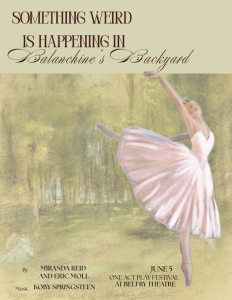
This piece was a huge artistic swing – and I’m delighted to say that it definitely paid off.
What starts as a regular ho-hum day at the dance studio for the lead ballerina reveals she isn’t finding the same joy as she once had. As the dances progress, we all discover that she’s not in a dance studio at all. The absurdity and short-circuiting of her world becomes harder and harder to miss as the show progresses.
It is somewhat daring to tell a story at a festival associated with playwrights and words almost fully through dance, and rely on the precision of dancers who didn’t have a long lead time to learn the show requires so much knowledge and skill. Bravo to triple threat director, writer, and choreographer Miranda Reid, and writer Eric Moll on this ambitious piece.
But looking into the programme, it’s so evident that this team of artists relied heavily on the strengths that each of them brought. All of the dancers are also credited with assistant choreographer roles, and it paid off in artistic cohesion and clarity.
I went back and forth if I wanted the reveal of the piece to start a little sooner, but I’m not sure that’s necessary. There was such a joy in the dance of this show. From a theatrical perspective, I might have liked to have seen some of the dialogue during the dances (I don’t even know if that’s possible, my apologies dancers if I’m casually suggesting something akin to hiking Everest in a day), and perhaps a bit more physical interplay between the dancers.
I think this show hit exactly the correct length as they presented it, and so could be an excellent candidate to tour fringes next year. If not, I hope they remount it again in town soon – I know I’ll be in line for tickets!
Ask the Oracle
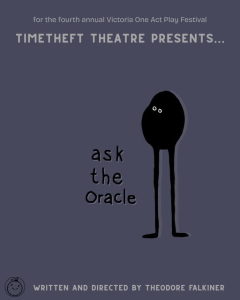
The premise of this play was so smart because the absolute absurdity of the oracle was only possible because the characters Nick and Julia are both so obviously “real” (put your socks away, Nick!!!). We’ve met these people, we know these people, maybe some us of were these people (or are, no judgement either way).
The awkward unknowing of not knowing what to do next and not knowing how to face our next steps is such a rich feeling to lean into and build a story upon, because I truly believe it is so universal. When the absurd element of possibly the least effective oracle of all time enters the picture, it’s such a hilarious contrast. The weirdness isn’t out of line because the reality is so very real.
Basically, Nick’s girlfriend is hinting at what comes next on their third year anniversary date. Julia is so smart, so funny, warm, and dedicated. A real spitfire! Nick… well Nick is sweet, but lives in a moldy apartment and thinks pasta at home is an appropriate three year anniversary dinner. At the behest of his kid brother, Nick seeks out the oracle who predicted his parent’s divorce many many years ago. After an epic hero’s journey, Nick ends up with the out of work, deadbeat oracle as a roomie. The oracle (played by Sadie Kupery) absolutely killed it – bringing the sad clown energy with the perfect deadbeat roommate vibes. Hilarious, only because it’s happening to someone else.
A similar criticism to the above Games Night is that while the show was delightfully madcap, sometimes the energy overflowed and ended up snipping lines or rushing a little too much. If there was more time, I would have also loved to see more tension between Julia and the Oracle. Similarly Nick seems such an obvious flip-flopper, I think there’s some perfect opportunities for comedy with him trying to balance the needs of the Oracle and Julie at the same time.
It’s really such a joy to see a funny show lean into the funny at all the right moments, from top to end, this show had us cackling.
Be Free!
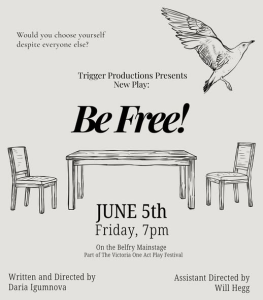
Be Free! was another movement based piece with many dance moves throughout. Be Free! was a heavy ask for the audience, focusing on the abusive relationship of a couple, and the family dynamics that lead to the female staying. Each of the characters has an internal self that is physicality through a movement/dance figure.
It was beautifully handled. It asked a lot, and told a difficult story unflinchingly. Asking the audience to come along to delve into the roots of (character) Female Speaking’s understanding of her place in the world, and her ability to ask for what she wants and needs is just heartbreaking.
If this show comes back, I would love to see more time devoted to the main leads relationship in development, as time progresses quite quickly, and we have to fill in the blanks ourselves.
I was delighted to get another chance to see Savannah O’Heany who also played in Motherland and later in Blessed and The Hungry as well. Here she leaned into her dramatic role with an exhaustion that was felt so beyond her years, she was so utterly devastated and exhausted.
As we journeyed with these characters through the worst of what they had to experience, we felt the love and passion of their physical selves. It is beautiful as it is challenging.
Death, the Dance, and the Girl
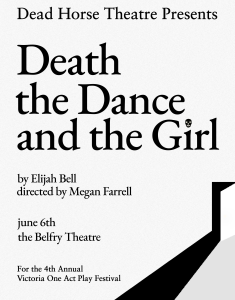
This profound, heartbreaking, and yet, somehow… funny script was possibly my favourite of the festival. Subtlety nuanced and winking back to lore and myths, this show begins in a waiting room. Tired and lights flickering, Death waits impatiently behind the desk. Soon, we meet Aphrodite, who, we are told, is dead.
So much of this play is through the eyes of Aphrodite, who we are told she is seeing something different from other characters. It lends itself to the unease, but also her telling us what her reality is, without needing to rely on difficult scene transitions.
The vastness of what is being asked of us as an audience is truly profound, and yet it does so with warmth, love, and laughter.
I appreciated the work by all three actors in this piece, although volume was a slight concern. I want to note Violet Brownsey’s touching portrayal as she absolutely stole my heart as the tough but soft underbelly Aphrodite. Her performance had a lightness to it, and she played so wonderfully into the curiosity of the character that made this tough fighter instantly likeable. I would also like to take a moment to also commend Maggie Jean Martin in her portrayal of Grant. For a minor character in a show with two big lead roles, there was a sharpness and professionalism to Grant that immediately set the tone, and also allowed for most of the comedic relief.
This play asks us to comfortably settle into the banality of death, and somehow, we do.
Blessed are the Hungry
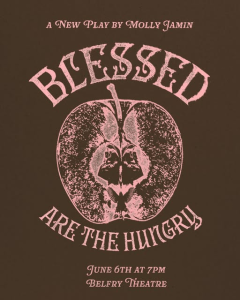
This was an incredibly ambitious piece to take on. With so many moving parts, a profound philosophical and moral deep dive, there was much to take in and enjoy with this piece. Two girls who fled wartime Albania end up in a convent deep in the forests near Thebes. We begin the piece with the sisters sitting around a dinner table, sharing a meal together, comfortably. We quickly learn that Mirela and Lena are both preparing to take their vows, although Lena is evidently struggling. As the play progresses, Lena finds herself in a pantry, overcome by hunger. This bottomless hunger, and her choice to give in takes us on a dark and unexpected journey that will rock this convent to it’s heart.
Playwright Molly Jamin has enough content in this piece for a full length show, easily. There is so much she touches on in this piece – the friction of being a “good” woman, denial, historical mysticism, a Greek chorus, and miracles arising from an unexpected source. Similar to Motherland above, I think there is so much that needs to be delved into further, this show might benefit from being made into a full length production.
As a production, this show worked overall but struggled in a few key areas. Primarily were the scene changes which were so detailed and required so much time, the flow of the piece was slowed down. There was just so much happening that it became quite busy to watch. An option in the future might be to have sisters flow in and out of the scenes, becoming physical representations of the passages of time and place.
This ensemble cast was so incredibly strong. With eight performers in the cast (often all on stage at the same time), all dressed in habits and robes, they were still somehow to easily able to indicate who each of the characters were with subtlety and without over the top characterizations.
To each and every single artist involved in creating these works – thank you. Our community, our arts scene, our world is better for you stepping up to take part, to tell stories, to share, and be brave. Thank you!
If you’re interested in learning more about the one act play festival, check out between words theatre at: https://betweenwords.ca/
Hi! My name is Kay Sammis, and I was the actor for Tyler from Game Night! Glad you had a fun time watching out wacky shenanigans :).
Such a fun time! Hope to see you on stage again soon!
Hello, Christina.
I’m the accompanist/author/composer from Landlord’s Game. Thank you so much for your gracious words!
I, too, hope to re-mount the production and add some more musical numbers, now that I feel more confident that people will want to listen to more of what I compose.
If we manage to re-mount it, I cordially invite you to join us again!
Sincerely,
Sean Weeks
Hi Sean! I sincerely hope you do! I’ll keep my eyes peeled for upcoming shows!